DeepRoller · Made in South Korea

It only counts if it reaches.

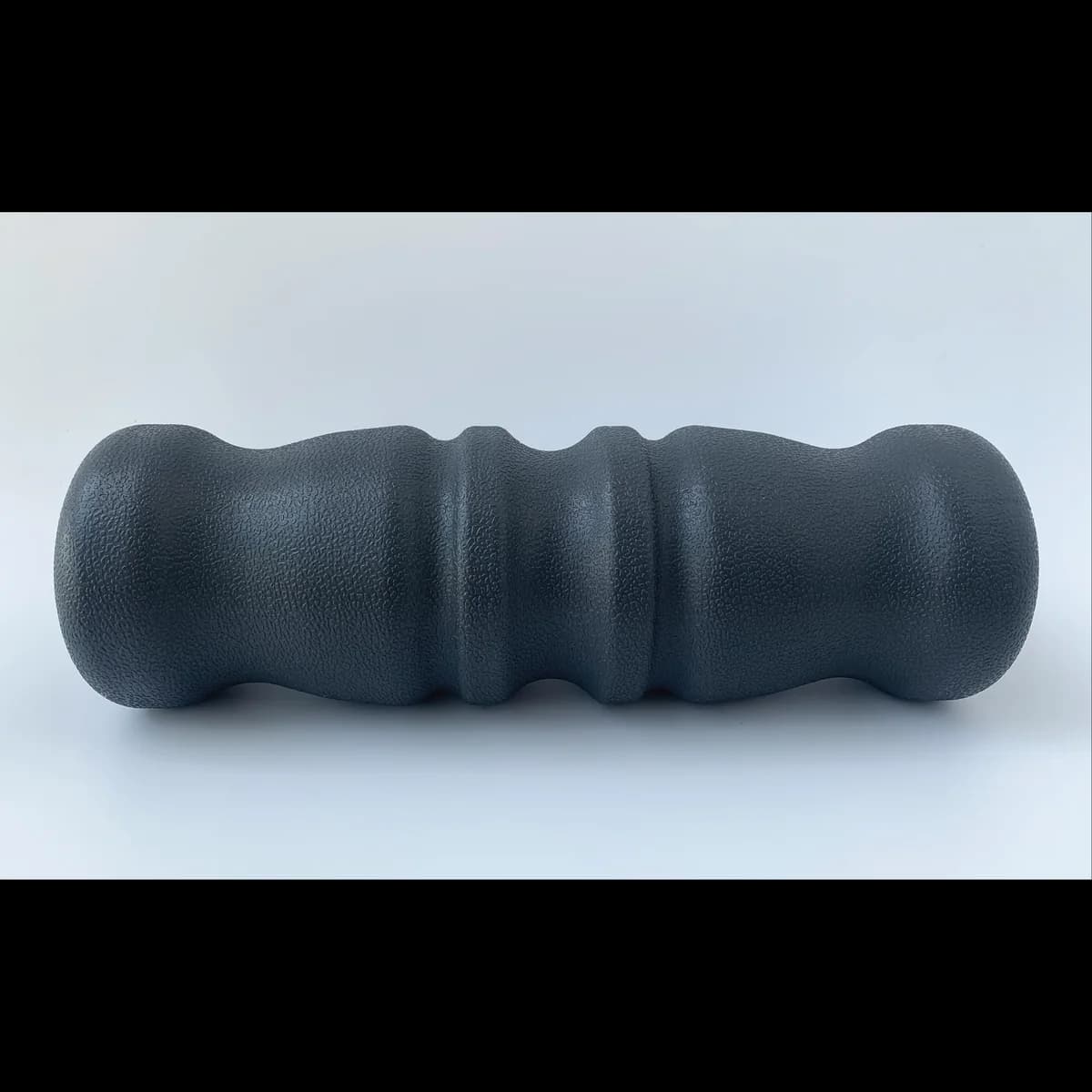
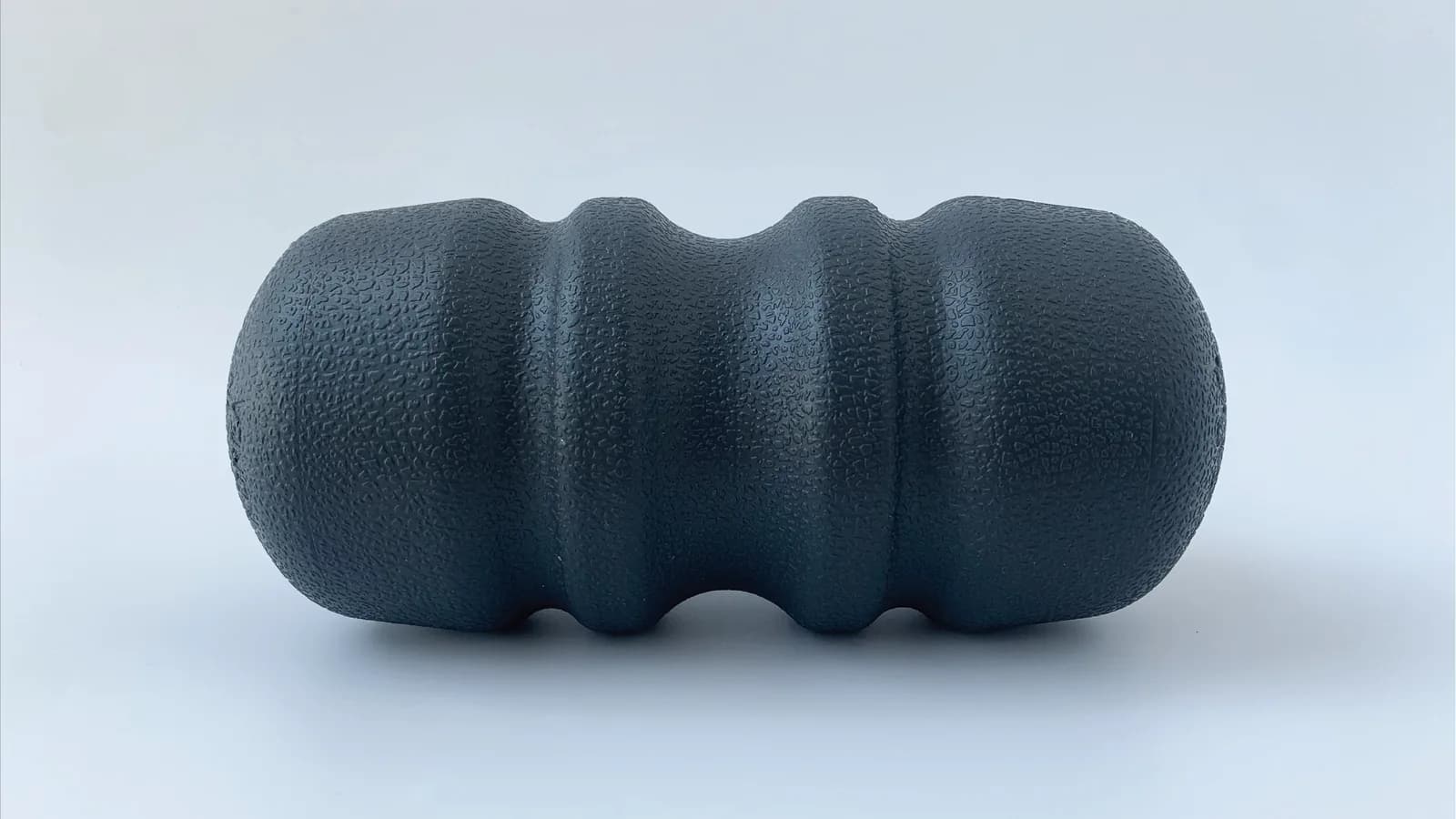
A straight cylinder rides the ridge of bone down the middle of your back and stops there. Every roller in this line is cut away through the center so the contact drops past that ridge and lands either side of it instead.

That geometry is the product — not a softer roller, a different shape. Three sizes of it, one material, no motor and no app. Three questions name the one that’s yours.

For the long sit between meetings, the middle seat on a long flight, the floor of a studio. DeepRoller is exercise equipment — nothing on this page is a health claim.

PU65 · 65 × 155 mm · dark graphite

Why it’s shaped like that

The waist isn’t styling.

Lay a straight cylinder across a back and it rests on the ridge of bone running down the middle. Every roller in this line is narrowed through the center so that ridge passes underneath, and raised either side of the gap so those parts carry the weight instead.

The profiles aren’t identical — the Travel Roller has a single waist, the two larger models a ridged center — but that’s the reason for all three. Separately, one invention in this line is granted as a patent in four countries.

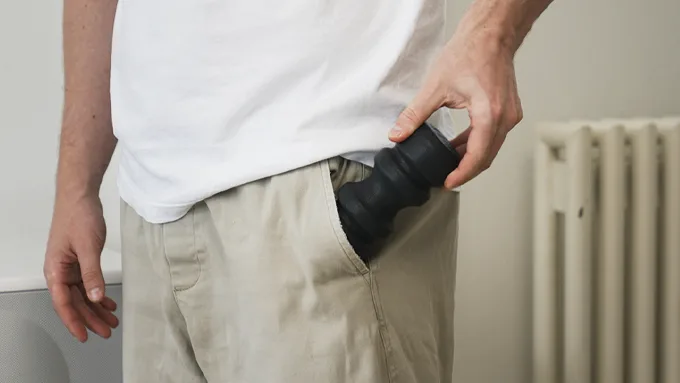
And it kept the small one small. A roller that works either side of a ridge doesn’t have to span a whole back, so the Travel Roller is 6.1 in (155 mm) long and about 5 oz (150 g). Fitting in a pocket wasn’t a feature anyone added — it’s what an object that size does.

The Travel Roller being slipped into the front pocket of a pair of trousers
6.1 in (155 mm). Front pocket, no case required.
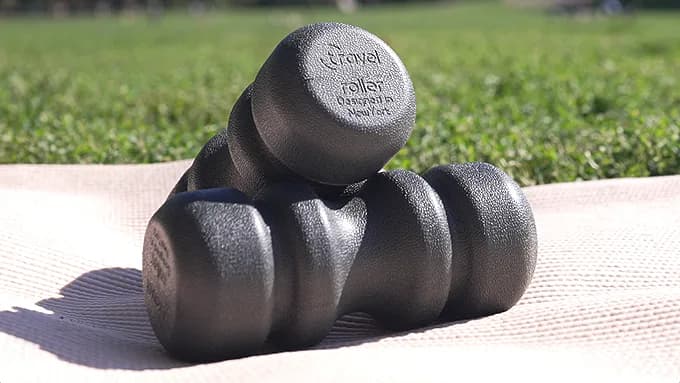
Two Travel Rollers resting on a mat outdoors, showing the molded surface and the engraved end
Integral skin foam: the surface is the same piece as the inside, not a cover over it.

Why we print the numbers

You probably already own a foam roller.

It’s behind a door somewhere, or standing in the corner of a closet. If it didn’t get much use, that’s not a discipline problem — nobody told you which one you would actually reach for, or where to keep it so that you would.

Part of the reason nobody told you is that the listings don’t say much. High-density EVA. Firm. Deep tissue. Words, not measurements.

In October 2024 the Korea Consumer Agency ran twenty foam rollers through a lab. Within EVA alone — one material, one word on the box — firmness ran from 153 N to 441 N. Near enough three times the difference, all sold under the same description. Counting EPP as well, the spread went to 2,027 N.

DeepRoller wasn’t one of the twenty. We say so because a page that leans on a study it wasn’t part of, and stays quiet about that, is doing the thing this section is complaining about. The agency’s report, in Korean (opens in a new tab)

So every model here publishes its diameter, its length, its weight and its Shore A. Where we don’t have a figure, the cell stays empty instead of getting filled in.

Put a roller that publishes its numbers beside one that doesn’t. The basis for choosing tends to shift.

See the three, side by side

Who made it

Made by a physical therapist who kept seeing the same backs a week later.

Hee Soo Kim trained as a physical therapist in Korea and spent more than twenty years treating people. However well a session went, a week later many were back, stiff in the same places. The roller began as a way to lean your own weight into those places without him in the room.

The first version, in EPP foam, was too much on tight spots and slid across the floor. The second came out too hard. The third is the one on this page.

Read the whole story, failures included
The finder

Three questions. One model. No email.

Diameter decides how concentrated the contact is. Length decides what you can lie along. Weight decides whether it stays home. Tell us how you plan to use it and the answer appears on this page — there’s nothing to sign up for and nothing to wait for.

0 of 3 answered
STEP 1Where do you want to start?
STEP 2Where will you use it?
STEP 3How much pressure do you want?

The line

Three rollers, $69 to $125.

One material across all three, PISF, made at three hardnesses. The numbers under each name, and the profile, are the difference between them.

Side by side

What actually differs.

Eight rows, three columns, no marketing adjectives except the one we derive from two of the numbers and label as derived.

Every figure below is the manufacturer’s published measurement. Scroll sideways for the full table.
PropertyPU65Travel RollerPU90DeepRollerPU95DeepRoller
Diameter2.6 in (65 mm)3.5 in (90 mm)3.7 in (95 mm)
Length6.1 in (155 mm)7.9 in (200 mm)11.8 in (300 mm)
Weight5 oz (150 g)11 oz (320 g)1.1 lb (490 g)
Hardness55–60 Shore A63.5 Shore A55.5 Shore A
FeelSharpest contactFirmer contactSoftest contact
MaterialPISFPISFPISF
In the box
  • PU65 roller
  • Carry case
  • Video guide (QR)
  • PU90 roller
  • Pouch
  • PU95 roller
  • Pouch
Price$69$80$125

Feel is the rank you get from hardness against diameter, not hardness alone. PU65 is a softer material than PU90 and still the sharpest of the three, because 65 mm spreads your weight over far less surface.

The record

Everything here has a source.

What this shelf cannot answer, what we can produce the paperwork for, and what buyers said — including the one who thought it was too short.

Why this one

What a $13 cylinder can’t answer.

Six facts about this shelf and this roller. Each is a number you can check, not a claim about what will happen to your back.

  • Everything above $75 has a motor.

    We read every SKU from nine recovery brands’ own storefronts in August 2026. No passive roller in the US holds price above about $75, and the cheapest powered device from a credible brand is $119.99. The only way past that wall without a motor is a shape a plain cylinder cannot make.

    US market assessment, August 2026

  • Professionals pick smooth. The shelf sells spikes.

    In a 2025 survey of 776 sports and rehabilitation professionals, 82.9% said they prefer smooth rollers over textured ones. Aggressive texture is a retail idea, not a practitioner one. This surface is smooth, and the geometry does the work instead.

    Bartsch et al., Frontiers in Physiology, 2025

  • The big names stopped making manual rollers.

    Therabody sells no manual foam roller at all. Hyperice sells one non-powered item across roughly thirty. Their attention went to motors and beauty devices, which is why the manual shelf below them is stocked mostly by $13 cylinders.

    Brand storefronts read August 2026

  • Designed by a physical therapist, not a product team.

    Hee Soo Kim has practised as a physical therapist for more than 22 years and has performed over 100,000 manual therapy sessions. The roller started as a way to reach the places he was reaching by hand.

    Korean physical therapy license, 2003

  • The registrations are numbers you can look up.

    One invention in this line is registered in four countries. In the US there is design patent D902,421 and trademark Reg. 6,207,649. Across the company the portfolio runs to 131 filings in seven countries, 95 of them registered.

    Registry records, March 2026

  • Most of what we make already leaves Korea.

    About 90% of revenue in 2024 and 2025 came from exports, mainly to Russia and the CIS. This is not a first export attempt with a US website attached to it.

    Company tax filings, 2024–2025

The record

Things we can produce the paperwork for.

Four facts, each with a document behind it. Anything we can’t show you a number or a registration for isn’t on this page.

  • $58,894

    1,055 backers pledged $58,894 on Kickstarter.

  • 4 countries
    Korea
    10-2001390
    Russia
    2753640
    China
    ZL 2019 8 0042679.1
    United States
    US 12,083,065 B2
  • US registered
    Design patent
    D902,421
    Trademark
    6,207,649
  • 365 days

    Warranty coverage, counted from delivery, on every model.

A patent registration is the result of an examination for novelty and inventive step. It’s not a medical guarantee and says nothing about what the product does for anyone.

DDP — no surprise customs fees at delivery. Ships from South Korea.Import duties and taxes are paid before the parcel reaches you, so the price on this page is the price you pay.

What buyers wrote

Including the one who thought it was too short.

From people who bought the PU90 in Korea. All of them, and how we chose

Chosen by us, written by people who ordered through the platform named on each card. Korean reviews are translated by us; Kickstarter backers are quoted in their own words. Where we shortened one, the cut is marked […]. Buyers describe their own experience; yours may differ.

  • […] Before this I used a tennis ball, but it kept moving out of place and felt a little too small. This is a good size and it does not slide, so it has become a favorite.

    DeepRoller PU90 · Kakao Makers, 2020/01 · shortened · translated from Korean

  • I think it suits someone who wants something portable more than someone after whole-back or full-body rolling. The firmness is right, and it is very good on the neck and lower back, but lining it up for the legs and shoulder blades is a bit tricky. It does what it is for, so I am satisfied.

    DeepRoller PU90 · Kakao Makers, 2019/12 · translated from Korean

  • It looked too expensive and too short, and I went back and forth for a long time. I bought two anyway, one for my mother and one for me. It really is small. But when I decided it would not do and went back to the foam roller I already had, that feeling was not there. These days I only use this one. The thickness is right and so is the material. My mother uses it on her back, lower back and neck and has no complaint about the length. I mostly use it on my legs, so it is a bit awkward, but I expect I will get used to it. […]

    DeepRoller PU90 · Kakao Makers, 2019/12 · shortened · translated from Korean

Still not sure which one?

Three questions, no email, and it names one model. If you already know, the line runs from $69 to $125.